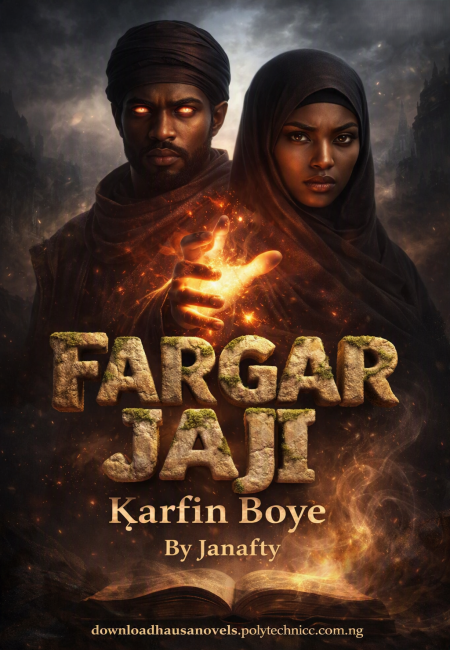
FARGAR JAJI
Hook
What happens when a seemingly peaceful family carries old wounds that nobody is willing to name?
In Jimeta, Ummu-Salma Hadi Baba appears to have the kind of life many young women would envy. She has a loving husband, a beautiful home, supportive parents, loyal friends, and a marriage filled with affection. Habib is devoted to her, attentive to her moods, and openly proud of the woman he married. Yet beneath the warmth of their relationship, something is changing.
Ummu-Salma has begun feeling strangely weak. Her body is behaving differently. She is constantly tired, her appetite has changed, her stomach feels unsettled, and something about her health does not feel right. When she begins to wonder whether she might be pregnant, hope rises in her heart. But the first test destroys that hope.
At the same time, preparations for a prestigious royal wedding in Daura are pulling her family into a world of wealth, royalty, old relationships, unresolved resentment, and complicated family loyalties. At the center of it all stands Muhammad Lamiɗo, a man whose name carries respect, power, and mystery, but whose coldness has left several people wondering what truly lies beneath his silence.
And while everyone is preparing for celebration, nobody realizes that another story is quietly beginning.
A story of family.
A story of hidden pain.
A story of loyalty, forgiveness, marriage, motherhood, and wounds that refuse to remain buried.
Summary
FARGAR JAJI opens in Jimeta, Yola, where Ummu-Salma waits anxiously for her husband, Habib, to return home. It is unusual for him to be this late without calling, and every unanswered call makes her imagination run further. She tries to convince herself that nothing is wrong, perhaps he stopped by his family's house or simply left his phone somewhere, but the growing silence outside her home makes it increasingly difficult to remain calm. While she waits, the reader is introduced to her world, her personality, her marriage, and the people who occupy the most important places in her life.
Ummu-Salma's marriage to Habib is affectionate and playful, and their relationship is presented as one filled with genuine familiarity. Habib knows how to make her laugh, how to calm her when she cries, and how to turn an ordinary evening into something memorable. Yet Ummu-Salma has also been experiencing unexplained physical changes. She has weakness, headaches, body pains, abdominal discomfort, excessive sleepiness, and a loss of appetite. After suffering a miscarriage two months earlier, the possibility of another pregnancy carries enormous emotional weight for her. She begins secretly hoping that the changes in her body mean another child is growing inside her.
But FARGAR JAJI is not simply a story about Ummu-Salma and Habib. Her family introduces another layer of intrigue. Her mother, Ammah, is fiercely devoted to her husband and children, but there is one person whose place in her heart appears almost impossible to challenge: Muhammad Lamiɗo. Her attachment to him has fascinated Ummu-Salma for years. Even though Lamiɗo is distant, difficult to read, and often perceived as arrogant, Ammah continues to defend him and care for him with extraordinary devotion. This unusual bond has shaped the family in ways that Ummu-Salma does not completely understand.
As a grand wedding approaches in Daura, these complicated relationships become increasingly visible. The wedding belongs to a powerful royal family, bringing together people from positions of wealth, influence, government, and traditional authority. Ammah and members of her family travel to participate in the celebrations, while Saddam enthusiastically documents almost everything through social media. Through his posts, Ummu-Salma experiences the grandeur of the occasion from afar, watching the royal surroundings, elaborate celebrations, distinguished guests, and her family's participation in the festivities.
Yet beneath the glamour of the wedding lies an older conflict. Alhaji Hadi Baba has reservations about attending because of past grievances involving Fatima and the complicated history surrounding Lamiɗo. Ammah refuses to allow old resentment to prevent her family from maintaining relationships and honoring their ties. Her determination eventually persuades Baffa to attend. Their conversation reveals just how deeply past events continue to influence the present, and it becomes clear that the family is carrying memories that cannot simply be erased because everyone is dressed for a celebration.
Meanwhile, Ummu-Salma's relationship with her closest friends reveals another side of her personality. She is deeply attached to Sisna, Bestie, and Mami, and these relationships give her a safe place to express her fears and frustrations. Her conversations with Aisha, also known as Baɗɗo, are particularly important because Baɗɗo understands her more intimately than most people do. When Ummu-Salma suspects she may be pregnant, she turns to her for advice rather than immediately telling Habib. Their eventual pregnancy test, however, produces an unexpected result, leaving Ummu-Salma heartbroken and confused.
The novel therefore moves between domestic intimacy, family drama, royal celebrations, friendship, marriage, and the possibility of buried secrets resurfacing. What initially looks like the story of a young married woman enjoying a comfortable life gradually becomes something much larger. The relationships surrounding Ummu-Salma are not as simple as they appear, and the affection within her family exists alongside old disappointments, misunderstandings, pride, and wounds. The deeper the story goes, the more the reader is left wondering what the title truly means and whose hidden pain will eventually demand to be confronted.
Genre
FARGAR JAJI is primarily a contemporary Hausa family drama with strong elements of romance, marriage, domestic fiction, emotional suspense, and social drama.
The story combines the warmth of married life with the complications of extended family relationships. It also introduces royal and aristocratic settings, traditional family structures, friendship, education, wealth, social status, and the tension created when personal emotions collide with family expectations.
Rather than relying entirely on one dramatic conflict, the novel builds its appeal through interconnected relationships. Ummu-Salma and Habib provide the intimate marital storyline, while Ammah, Baffa, Lamiɗo, Balkisu, Saddam, Baɗɗo, and the wider family introduce deeper questions about loyalty, resentment, affection, and belonging.
Settings
The story is strongly rooted in Northern Nigeria, particularly Jimeta and Yola in Adamawa State. The opening scenes establish a domestic atmosphere inside Ummu-Salma and Habib's home, allowing the reader to experience their marriage through ordinary household moments, conversations, meals, social media interactions, and nighttime routines.
Jimeta provides the novel's intimate environment. It is where Ummu-Salma worries about her husband, communicates with her friends, cooks, reflects on her family, and confronts the uncertainty surrounding her health.
The story later expands toward Daura, where the royal wedding becomes an important backdrop. The atmosphere changes dramatically from the privacy of Ummu-Salma's home to royal residences, elaborate celebrations, convoys, distinguished guests, traditional authority, and the public spectacle surrounding a prestigious marriage.
The contrast between these locations is significant. Jimeta represents everyday domestic life, while Daura represents heritage, status, family reputation, and public expectations.
Core Themes
Marriage and Emotional Intimacy
The relationship between Ummu-Salma and Habib forms one of the emotional foundations of the novel. Their marriage is portrayed through teasing, affection, companionship, domestic routines, and genuine concern. Yet the story also explores how physical and emotional intimacy can become complicated when one partner is experiencing exhaustion, uncertainty, or emotional vulnerability.
Motherhood and the Desire for Children
Ummu-Salma's suspected pregnancy carries particular emotional significance because of her previous miscarriage. Her reaction shows that pregnancy is not merely a biological possibility for her. It represents hope, healing, and the possibility of rebuilding something she previously lost.
Family Loyalty
The characters repeatedly face situations where family loyalty competes with personal resentment. Baffa's hesitation about attending the royal wedding, Ammah's determination to preserve relationships, and the unusual affection surrounding Lamiɗo all demonstrate how family history can influence present decisions.
Forgiveness and Old Wounds
The story repeatedly hints at unresolved grievances. Characters remember what happened years earlier, even when others believe those events should have been forgotten. This makes forgiveness one of the novel's underlying questions.
Favoritism and Family Dynamics
Ummu-Salma notices that Ammah treats Lamiɗo differently from the other children. This observation creates an intriguing emotional imbalance within the family. Why does one child receive a level of devotion that appears different from everyone else?
Pride, Status, and Royalty
The Daura wedding introduces the world of social hierarchy, traditional authority, wealth, political influence, and royal prestige. The characters interact with people whose positions carry enormous social weight, creating a contrast between ordinary family life and elite society.
Friendship and Female Support
Ummu-Salma's friendships with Baɗɗo, Bestie, Sisna, and Mami provide emotional support and humor. These relationships also demonstrate the importance of women having people they can confide in when dealing with marriage, education, family pressure, and personal uncertainty.
Education and Personal Choice
The conversations surrounding Baɗɗo's education introduce the conflict between academic expectations and personal exhaustion. Her struggles show that young women can find themselves caught between what their families expect from them and what they believe they can realistically handle.
Key Characters
Ummu-Salma Hadi Baba
Ummu-Salma is the central character introduced at the beginning of the novel. She is young, married, expressive, emotional, playful, and deeply attached to the people she loves. She enjoys cooking and learning modern recipes, maintains close friendships, and has a particularly affectionate relationship with her husband.
Beneath her cheerful personality, however, she carries emotional vulnerability. Her previous miscarriage has left an impression on her, making the possibility of another pregnancy especially meaningful. Her uncertainty about her health becomes one of the first major mysteries surrounding her character.
Habib Idris
Habib is Ummu-Salma's husband and one of the most affectionate figures in her life. He is portrayed as successful, educated, handsome, confident, and deeply attached to his wife. His playful personality contrasts with the more reserved personalities of some members of Ummu-Salma's family.
His relationship with Ummu-Salma gives the novel much of its romantic warmth, but his awareness of the larger family dynamics also places him in a position where he may eventually become involved in conflicts beyond his marriage.
Ammah, Jamila
Ammah is a powerful presence within the family. She is strong-willed, outspoken, affectionate, protective, and deeply committed to those she considers her own. Her marriage to Baffa is characterized by a striking balance between her fiery personality and his patience.
Her relationship with Lamiɗo is particularly intriguing. She treats him with extraordinary affection and loyalty, creating questions about the history between them and why he occupies such a special place in her heart.
Baffa, Alhaji Hadi Baba
Baffa is an older, composed, patient man whose personality provides a counterbalance to Ammah's intensity. He is a successful businessman and a respected father who has spent much of his life caring for his family.
Although he generally avoids unnecessary conflict, his past experiences and his relationship with Fatima place him in a difficult position when questions about attending the Daura wedding arise.
Muhammad Lamiɗo
Lamiɗo is arguably one of the most mysterious characters in the material provided. He is respected, wealthy, educated, connected to royalty, and emotionally difficult to read. He does not easily express affection, anger, or vulnerability, making it almost impossible for those around him to determine what he truly feels.
His relationship with Ammah is especially fascinating. She defends him, serves him, and remains devoted to him despite his reserved personality. His relationship with other family members, particularly Ummu-Salma, is far more complicated.
Aisha, Baɗɗo
Baɗɗo is one of Ummu-Salma's closest confidantes. Their friendship is built on years of trust and mutual understanding. She is the person Ummu-Salma turns to when she is frightened or uncertain, including when she begins suspecting that she may be pregnant.
Baɗɗo also has her own struggle with education and family expectations, giving her storyline an independent emotional dimension.
Shamsiya, Bestie
Shamsiya is another important friend in Ummu-Salma's life. She is academically driven and comes from a family where education is treated as a serious responsibility. Her friendship with Ummu-Salma provides another perspective on the different paths available to young women.
Hamma Saddam
Saddam brings humor, energy, and social commentary into the story. He is enthusiastic about documenting events, especially the royal wedding, and his constant updates allow Ummu-Salma to follow the celebrations from a distance.
His personality also provides comic relief within an otherwise emotionally layered family narrative.
Balkisu
Balkisu, Lamiɗo's wife, comes from a prominent background and is herself educated and accomplished as a doctor. Her connection to royalty and her relationship with Ammah add another layer to the family's social standing.
Her presence also reinforces the unusual position Lamiɗo occupies within both his immediate family and the wider royal world.
Analytics and Insight
One of the strongest elements of FARGAR JAJI is its character-driven storytelling. The novel does not immediately reveal every major conflict. Instead, it introduces seemingly ordinary situations and allows small details to raise larger questions.
The opening with Ummu-Salma waiting for Habib is particularly effective because the situation begins as something ordinary. A husband is late. A wife becomes worried. She calls him repeatedly. But the longer he remains unreachable, the more tension builds. The reader begins to wonder whether the problem is simply a delayed return or whether something more serious is happening.
Ummu-Salma's physical condition creates another layer of suspense. Her symptoms suggest one possibility, while the pregnancy test appears to contradict it. This creates uncertainty not only for her but also for the reader. The emotional importance of motherhood after her miscarriage makes this uncertainty more powerful.
The family storyline is equally compelling because Lamiɗo's character is surrounded by unanswered questions. He is not presented as an openly affectionate man. Instead, his personality is controlled and difficult to interpret. Yet Ammah's devotion to him is unmistakable. That contrast creates a compelling question: what happened between them that makes Ammah willing to defend him even when others cannot understand him?
The Daura wedding also serves a deeper narrative purpose. It is more than a glamorous event. It brings people together who might otherwise remain separated by distance, resentment, or circumstance. Weddings in family dramas often create opportunities for hidden tensions to surface, and the scale of this particular celebration makes the possibilities even greater.
Another notable strength is the contrast between public and private life. Social media presents the royal wedding as beautiful, prestigious, and exciting, while the family conversations reveal the private emotions beneath the photographs. The characters can smile for pictures while carrying memories and disagreements that the outside world knows nothing about.
Ultimately, FARGAR JAJI appears to be building toward the collision between the life people display and the truths they keep hidden. Its greatest suspense comes not simply from asking what will happen next, but from asking what has already happened that the characters have not yet fully confronted.
Why Readers May Find It Compelling
Readers who enjoy Hausa family novels with romance, marriage, emotional drama, strong family relationships, royal settings, friendship, and suspense are likely to find plenty to engage with here.
The story combines the comfort of domestic scenes with larger questions about family history. One moment the reader is inside Ummu-Salma's home watching her prepare food for her husband. The next, the story opens into the world of royalty, wealth, family politics, and complicated relationships.
The characters also have distinct personalities. Ammah's fiery nature, Baffa's patience, Habib's playful affection, Saddam's dramatic social media presence, Baɗɗo's loyalty, and Lamiɗo's mysterious reserve create a family environment that feels populated rather than empty.
Most importantly, the story leaves room for questions.
Why is Lamiɗo so emotionally distant?
Why does Ammah defend him so fiercely?
What really happened between Baffa and Fatima?
What is happening to Ummu-Salma's body?
Will motherhood become part of her future again?
And when old family wounds meet a major royal celebration, can everyone maintain the appearance of peace?
Those questions give FARGAR JAJI its strongest pull.
A Quote From the Story
“Sometimes the wounds a family refuses to speak about are the very ones that determine the shape of its future.”
Final Impression
FARGAR JAJI is a layered family drama built around love, marriage, friendship, motherhood, family loyalty, social status, and unresolved history. It begins with the intimate world of a young married woman in Jimeta and gradually expands into a much larger family story involving royalty, wealth, tradition, old grievances, and complicated emotional bonds.
At its heart is the idea that families can love one another deeply while still carrying wounds they do not know how to heal.
Ummu-Salma may think her greatest concern is simply understanding what is happening to her body and whether the future she hopes for is possible. But around her, another story is unfolding. Her family's past is still alive, and the people she loves most may be connected to secrets, resentments, and loyalties far more complicated than she realizes.
FARGAR JAJI is therefore not merely a story about what happens next. It is a story about what happens when the past refuses to stay buried.